Sunday, April 15, 2012

Le Course des Brasseurs


"Bienvenue à le troisième Course des Brasseurs!"

The small crowd of runners behind the thick white arch applauds, chats, or continues their warm-up routines. Strangely, I am one of them, despite my obvious lack of physical fitness. Seven months earlier I could've probably run the 10k, but the rich french food dragged me, wheezing, into the 5k. 

My maman suggested the race several weeks earlier. Roads are blocked off around Schiltigheim for the event, which raises money to help young low-income mothers. We weren't inscribed, but she had emailed the man in charge of the race, who assured us we could do so in the morning. At the sign-in table, two woman firmly told us we could not run without a paper from the doctor. Fortunately, there was a friend of maman supervising, who cheerily waved us through. 

Walking from the building to the starting line would normally take about 3 minutes. However, every few meters we were stopped by people greeting maman. As she commented the night before, all of Schiltigheim has her cellphone number. People at the vestiaire, runners, spectators, city officials… everyone seemed to know her. The mayor, who still looked professional in running clothes, stopped shaking hands and taking pictures to greet us. 

The crack of a gun sounded, we were off. The race was harder than I'd expected. I've gone running maybe five times since my arrival, not nearly enough to combat the disappearance of my muscles. I was breathing heavily after 5 minutes. 

Step. Suck air in. Step. Release air. The old men are passing me. Okay. Rhythm against the gray cobblestones. Eyes on the gray sky. There's a twist up the little street between the rows of colored houses. I can hear musicians playing for us up ahead, one of four little groups placed around the route. Turn the corner. A guy behind me curses in french, "What? There's more?"

About halfway through the race we pass my street, and my papa who applauds and gives everyone a grave "bravo bravo." 

Up the bridge. My breath is too fast, I slow down. A young woman in black clothes and hot pink sneakers offers a smile and "Courage, aller!" as she jogs on. 

A man with a megaphone gives us our times as we reach the fourth kilometer. "Now," I think, "is the time to push yourself." I can't. I feel spent, and jog slowly onward. Then, just as the finish line comes into sight, I feel fine and break into a run. Frustrated for not using this hidden energy sooner, I pass a man for the first time since the beginning stretch. 

Done. Walk dreamily through the barrier, a man scans the barcode on my number, another writes something down and I'm handed a black gym bag. I greet a boy I know from Scouts who hands me a glass of something pink and sweet, and then walk off to the nearest park where I lie down, even though I have a notion that you aren't supposed to do that after running. 

After a few minutes I make my way back to the finish line to cheer my maman as she finishes. She runs with a Europe ecology sign pinned to her back and a smile on her face, despite the strenuousness of the course. Instead of walking straight through like the others, she stops just after the finish line to greet people. 

After meeting a dozen more members of the community, the two of us walk over to the starting line and applaud as the gun sounds for the 10k. She stays for the awards ceremony, and I pedal home to shower and relax before leaving for the theatre this afternoon.


http://www.ville-schiltigheim.fr/canal-schilick/1796

Thursday, February 2, 2012

La capitale de Noël

I'm back! It's been quite a while. The busyness of school and the holiday season is not any less in France than anywhere else, and it was difficult to find time.
To write everything that's been happening is impossible, but I'll take things bit by bit.


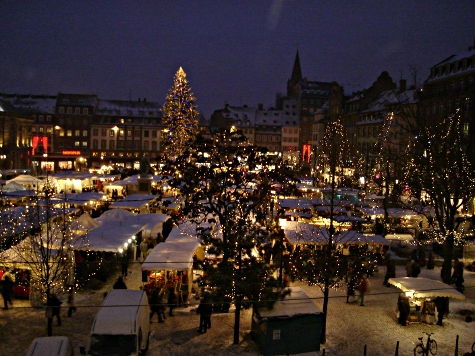
The marché de Noël (Christmas market) is an enormous tourist attraction for Strasbourg. Despite the typical drizzly gray weather, the streets are packed with pedestrians to the point where it's impossible to ride a bike through certain sections, much less find a free stand to lock it. The shops and trams are filled, and sometimes one can barely see what's being sold in the stands because of all the people pressed up against them.
Like advent, it begins four weeks before Christmas. I caught a bit of the opening ceremonies, but had to leave for a play. At the finale, the Christmas lights all over the city are illuminated.
I believe Strasbourg could singlehandedly keep the entire lighting business in business. Purples, reds, and golds flood buildings, trees are roped with silver, everything sparkles and shines.
Lavishly decorated buildings and shops can be found throughout the city, but the marché de Noël has several specific locations. For example, la place Kleber has an enormous Christmas tree that towers over the nearby buildings and little wooden shops. Ornaments, toys, clothing, useful things and souvenirs of all sorts are sold. Crepes, hot wine, french christmas cookies, candied apples, baguette flambées, and an infinite number of other foods perfume the air.
But the alleys away from the marketplaces are more lovely. Store windows glow, displaying chocolates, clothing, books... one street in particular is hung with crystal chandeliers (publicity, but beautiful nonetheless).

I looked out over this scene when I climbed the winding steps of the cathedrale for the first time. Faint accordion music drifted up from below, where figures glided around the skating rink and the people moving through streets were mere dark spots against the lights.

I didn't buy any souvenirs, I don't think they would've reminded me much of the marché de Noël. I think of the warm drinks, street musicians playing carols, hot chestnut vendor, and wandering groups of tourists. 

Strasbourg is certainly not the only place with a marché de Noël. Other cities have smaller versions and even country villages set up little wooden houses to sell their crafts and food. My family stopped at one during a hike to buy mistletoe and Christmas tea. The churches sometimes set up crèches (manger scenes) which can be very elaborate. 

Strasbourg has been celebrating Christmas with a market since 1570. That's right, America. This party started over 200 years before you were born.

By the way, the stork is a symbol of Alsace, which is why my fellow exchange student bought this hat for his brother and let me wear it while we were clearly being tourists in Colmar. 

Wednesday, November 23, 2011

Mathématiques


On my first day of school, after accidentally being brought to the wrong class, I walked into math. I had heard that Europeans were far better at mathematics and sciences than Americans, so I expected the lessons to be impossible to follow with my level of french. Fortunately, I am in the literature (L) section, and the math enthusiasts are in the science or economics divisions. I also only have 3 hours a week.
<- Here is a random page from my textbook!
In France math isn't divided into algebra, geometry, etc, but so far the course material seems similar to trigonometry, which I took last year. Therefore, I usually have a pretty good idea what's going on even though the lesson's in french. It's the only class where I can explain to other people rather than vice versa.
My professor assured me I can ask him if I don't understand something, and the atmosphere is relaxed enough that I can ask the people next to me too. Math might be my most casual class, which is useful because we can figure out the problems together if needed. 
Still, that doesn't mean it's easy. On our first test I misinterpreted the directions and received a 3.5/10, with the remark, "Attention, vous ne répondez pas à la question posée." Whoops.
Obviously, the most difficult type of question is a word problem. Word problems are much more common here than in American high school. For example, yesterday we were tested on percentage of augmentation and reductions. One question, although I understood all the words, bewildered me. It seemed to be asking this: "If 5% of L are boys and if 8% of boys are in L, there is necessarily more boys than students in L."
Well there can't be more boys than students, can there? I raised my hand. " Pardon, Monsieur, je crois que je comprends pas la neuvième question." He tried to explain, I got it wrong anyway. Ah well. 
In class we work out of the textbook (which is developed for ES and L students), take notes (thankfully from the board), and complete problems on the chalkboard. There's not too much homework, but the few tests given are important. 

I realize my notes may look OCD to Americans… I'll explain that tomorrow. I haven't had a lot of time to post lately but I'll try to keep up better than I have. :)

Friday, November 11, 2011

America: The view from across the ocean


First let me clarify that although a lot of the things mentioned below are negative, the French do not dislike Americans. The culture is quite different, and obviously they prefer their's, or they would not live in Europe. Also, a lot of the conceptions about American life are based on media, especially movies. Of course, films do not usually provide a normal glimpse of everyday life. 
Speaking of films, the United States has a reputation for producing stupid movies without any artistic value. I've seen enough predictable chick flicks and over-dramatic action movies to agree. Still, even the french, especially teenagers, enjoy a good stupid movie now and then. 
A lot of people have asked me questions about things they've seen in American films like, "do people really put kick-me signs on other people's backs?" The most common question I get is about high school. The impression is that the quarterback is always with the head cheerleader, and they rule the school social scene. Of course, they phrase it differently, since I'm not sure "quarterback" and "cheerleader" exist in the french language. They say pom-pom girl, which reflects the general negative attitude towards the activity. 
One person told me that she had a friend who went to the US and said school was really like that, with big metal lockers and everything. I tell people that it depends on the school, and although it's not as dramatic as disney and hollywood make it out to be, the student body is more clique-y than in France. 
As for adults, the perception is that they drink a lot of coffee and work a lot. Our country does consume a lot of coffee, but I don't think we're work-a-holics. This view probably stems from our capitalistic "if you work hard enough you'll succeed" attitude. 
They also believe that families have multiple, big cars and don't care about the environment. I think that most people do care, they just don't do as much about it as Europeans. It seems that there is a lot of finger-pointing and talk about reform, but very little gets done. Here, measures are constantly being taken by the government and individual families to improve conditions. They think the US is not doing their part. 
When I was  talking with a friend, she pointed out to me that American's tend to say "we did this" instead of "they did this" when referring to the government. For example, I might say, "we had a problem with the Mexican border, so we decided to…" even though I had no direct influence on the decision.
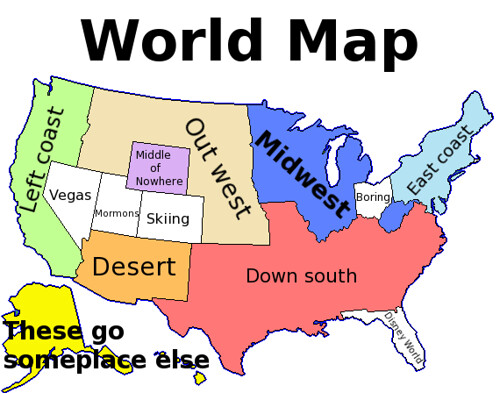
Some people apply the Texas stereotype to all the country. I've been asked a few times if I have a gun, if my family has guns, etc.  
We're known for an impossibly expensive university system. Education and health care are two things that are significantly cheaper in France. The US is also looked at as very conservative because we tie for the highest drinking age in the world, ban the purchase tobacco to those under 18 (or 19 in some states), and seem to censor everything. 
There is a slight notion that American's aren't too polite. This is partly true, but party cultural. In public, I think Americans have a subconscious idea that since they are the consumers, businesses should accommodate them, not the other way around. Also, if I walked into a room in the United States, waving and saying "hello" would suffice for everyone. In fact, If no one directly addressed me I might not even have to do that. In France it is the opposite. I would have to greet each person individually, be introduced if we hadn't met before, and give la bise. Students never enter or leave a classroom without saying hello and goodbye to their teachers. There are many things like this which aren't important in the US, but would strike a European as impolite. 
Truthfully, if you ask someone what the first things are that come to mind when they think of America, they'll probably mention McDo. It fits four stereotypes: overweight, rushed people who don't sit down and eat healthy food as a family. I believe few people eat fast food as often as the french believe, but it's more common than here. And I agree that you're more likely to eat a healthy home-cooked meal at the table with your family in France. 

Of course, all these things are generalizations of both cultures, and not everyone thinks or acts this way. 

Friday, November 4, 2011

La langue: deux mois

I glanced at a box, looked away, and suddenly wondered why it was in english. I looked back. It wasn't. I had just read the top without thinking about it.
I catch snatches of conversations when I pass people on the street.
One day I read a sign and then realized I had read the sign. And this was no billboard with "voulez-vous?" and a picture of a car, this was 4 whole sentences. Impressive.
I can understand a lot of the news on tv without relying on the footage.
By now I can pick things up at the store without having to explain that I don't speak french.
Wait. Notre Dame means "our lady" of course. And Lefou in Beauty and the Beast is "the crazy." I see what you did there, Disney.
Small victories. 

A few weeks ago I bought a gigantic pad of colored paper squares and started writing words I wanted to learn. I stick them on the wall beside my loft bed, and when I'm sure I have all the meaning's committed to memory I take it off and write something on the other side. Hopefully the red will quickly disappear, and then the orange and yellow….

There are some words which I'm not sure how I picked up, and there are some which I remember someone explaining to me. But for the majority I can recall hearing them, looking them up, forgetting them, hearing them again, looking them up again, writing them down, forgetting them, looking at the paper, and finally remembering what they mean. Memorization has always been difficult for me, from formulas to lines in a show. Once I do learn a word, I hear it everywhere.
There are a number of words that are close to the english equivalent, but it's risky because there are also a lot of faux amis (words that sound similar but mean very different things). I also have to work around phrases like "it doesn't matter" that don't translate with my dictionary. 
Reading is easiest, because I have time to look at the words and see if they're similar to those know if I don't recognize them. Writing is alright if you ignore my grammar, because once again I can take my time. Listening is difficult, but it's nothing compared to speaking. I have to quickly arrange the french words I know so that the other person will understand, and say it properly. I understand many more words than I can remember off the top of my head. 
Still, my friend tells me "Your sentences make sense now!" so that's… encouraging.

At this point, I can have a conversation with someone if they're willing to go slowly and stop for clarification. I can also understand most of a conversation between two people. But participating in a conversation with a group is difficult because they're usually speaking fast (or at a normal speed, which is fast to me), and going from one topic to another. 

Another problem is I'm getting better at the basics, but missing the key ideas in a conversation. For example, listening to two people, I hear something like this:
"So yesterday I decided to ___."
"Oh really? That's good, I wouldn't want you to be ___."
"No, actually it's more ____."
"Maybe tomorrow then."
I understood most of it, and yet none at all.

Now that I've been here two months, people are beginning to ask me "are you fluent by now?" No. No I am not. When people said things like this last month it was funny, but it's beginning to be rather depressing.

However, I am pretty good at telling people that I don't speak french and why, where I'm from, how long I'll be here, who I'm living with and the school I'm attending. The range of topics I'm good at is so dry.

AFS Friends
I knew the meaning of what sounded like "on hiva" but I couldn't figure out how it was spelled, and therefore couldn't decipher the literal translation. One day while checking facebook I saw it in a sidebar advertisement. It was actually "on y va." Thank you, facebook.
I also kept hearing "comme mȇme," which I thought must mean "like the same." But it was actually "quand mȇme," an expression which has about five different uses.

I'm not afraid of answering the door now, because now I can manage without having to explain that I don't speak french. The phone is still scary.

Any picture of me since September is a picture of me learning french, so here's one with two other exchange students, Manu and Shuangyi at a reunion last month (taken by Eli).

Tuesday, November 1, 2011

Le prix et le temps


At orientation one of the volunteers asked where I was going, and when I said Alsace she immediately replied "oof, rainy and cold."
It didn't seem rainy and cold though, perhaps because I come from upstate New York, which is snowy and cold. There is a lot of mist at night and in the morning, which I love. September was generally beautiful, lots of warm and sunny days. The rain didn't seem unreasonable, except once when we were out hiking and barely made it back to the car on time. 
Of course, as it became fall the temperature dropped from 25˚ (77F) to 6˚ (43F). The worst was riding my bike 15 minutes to school in the morning at 7:45, but it wasn't too bad. 
Then one morning it rained. Foreign exchange requires you to do a ton of things you wouldn't normally, and most of them are good, but riding a bike in freezing rain is not. The worst part about it was that it was Wednesday on a week when I only have one class in the morning. By the time feeling had returned to my hands and they had their normal color, I went back into it. Fortunately the rain cleared before I returned in the afternoon. 
That day I realized there was no way the four flimsy sweaters I had brought were warm enough. It wasn't even November yet. I decided I wasn't going to buy anything that wasn't warm. Which brings me to the next topic.
I went shopping with two things in mind: warm sweaters and a giant scarf. Every shop sells these, because in France (or Strasbourg at least) people dress for the weather a lot more than in the US. Hardly anyone wears short sleeves to school after September, and they usually have scarves and hats even if it's just chilly. 
I walked into a store and immediately found the warmest sweater I had even seen. It was thick and lovely and… oh 40 euros ($56). Hmm. This one's 30 euros ($42) but it has short sleeves. Oh that shirt's only 10! But it's sleeveless, that's useless. 
Clothing is generally made better in France, but is also more expensive. Even H&M is noticeably more. 
Food is also generally made better in France, and is also more expensive. The only exception to this is bread and pastries, which are actually cheaper. Two weeks ago I ate with friends before seeing a dance show, and they decided to go to "MacDo". I thought "well at least it won't be expensive." Wrong. True, it was actually better than US MacDonald's food, but I still wasn't expecting to pay 11.20 USD for a salad and medium fries. Whoa. That's twice what I paid for the delicious pesto I had for lunch. Who would pay $6 for a 6-piece chicken nugget? Apparently a lot of people, the it was a busy place. 
If MacDo was the only thing with higher prices things would be easy, but folders, floss, books, and pretty much everything else costs more. I don't know if this has to do with the value added tax, the economy, or the materials, but it took time to adjust to. 
I'll end on a positive note by going back to the first topic. This past week (of vacation) has been beautiful. It was even warm enough to sit outside with my dictionary and papers. Today there's a high of 17˚ (63F). 

Sunday, October 30, 2011

The food: mmmm

I know it's been quite a while since my last post, and since I've been on vacation I have no excuse. I apologize.
This deserves to be a be a really long post.
Of course, meals and eating habits vary by family. Mine might be more traditional than some, but in general the trends are the same. 

Breakfast is a bit more important than in America. There's tea, orange juice, milk, or hot chocolate in a bowl. Usually I have bread with honey, jam, or nutella, but sometimes there's granola or pastries instead. When I don't have to rush to school or I'm not eating with someone else I read the paper. Or rather, I stare at the paper and absorb the general meaning of the articles. 

On Wednesday I have a long break in between my morning and afternoon classes, and on Thursday I don't start until the afternoon, so I eat at home those days.
At school I only buy my lunch with the others once or twice a week, because it's definitely pricier than LACS cafeteria lunch. A bunch of little shops 5 minutes away from the lycée sell food à emporter (to take out). Pasta is especially popular. The bakery/pastry shop down the street sells sandwiches (made with fresh baguettes) to those in more of a hurry. 

At dinner  the courses are more separated than in the US. You eat one thing, then the next, perhaps salad, cheese, bread, and just when you can't possibly eat anything else, dessert. And you find that it is very possible to eat more.
Alsace is known for it's wine and potatoes, so there's quite a lot of both.  Vegetables are sometimes cooked and pureed with the mashed potatoes, which is really delicious. 
Dessert is sometimes pie or cake (it's not cake in the American sense but I don't know what else to call it), but more often yogurt or fruit.
Sometimes after the meals tea or a small cup of coffee is served. It's not as rushed as a typical American meal, and everyone sits at the table until the end. 

I feel that in America it's acceptable, perhaps even polite, not to finish absolutely everything on your plate. But to scrape the sides of the soup bowl or pick up every last morsel of food on your plate is expected in France. In the first week I didn't finish something entirely, and it was assumed that I didn't like it.

I'm often asked if I like a food or the meal, and I always answer yes. This is not mere politeness, it is the truth. It's actually a joke with my family that I never say no. On October tenth I answered "no" to a question and it was written up on the refrigerator whiteboard beside the shopping list and phone numbers. 

Contrary to American belief, the french typically eat a lot more at meals. However, the food is healthier and there is less snacking. Most people have something in the afternoon, perhaps with tea, but that's all. Since dessert is served directly after the meal that's usually the last thing eaten for the day.

Last month I told my friend, "The food is SO good. I'm going to roll back to the US."
"No," she replied. "French people are skinny."
The next day she mentioned it to the LACS french teacher, who agreed that it was unlikely, since the french walk or bike everywhere.
Yet, here I am, 6 pounds the heavier.
It's probably the bread, the potatoes, and the cheese. None of which I would think about giving up. So let's hope my body realizes it doesn't need to savor the food as much as I do. If not, I will continue the tradition of AFS: Another Fat Student.

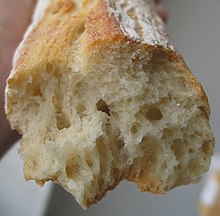
The bread is really, really, good. Usually we get ours from the local bakery two blocks away, but sometimes elsewhere. This weekend was the first time I saw sandwich bread in the house, and I was honestly surprised. The cheese is not really comparable to American cheese, because it's completely different. I thought I loved cheese before, but now…. Both of these things are present at a typical meal.

Basically, everything is delicious.

*The photos aren't mine, sadly. The first is a pain au chocolat (breakfast!), the second is a popular place for students to get lunch, and the third a typical size of a cup of coffee. The tomato mozzarella combination is sometimes part of dinner, and the bread's... wonderful.